
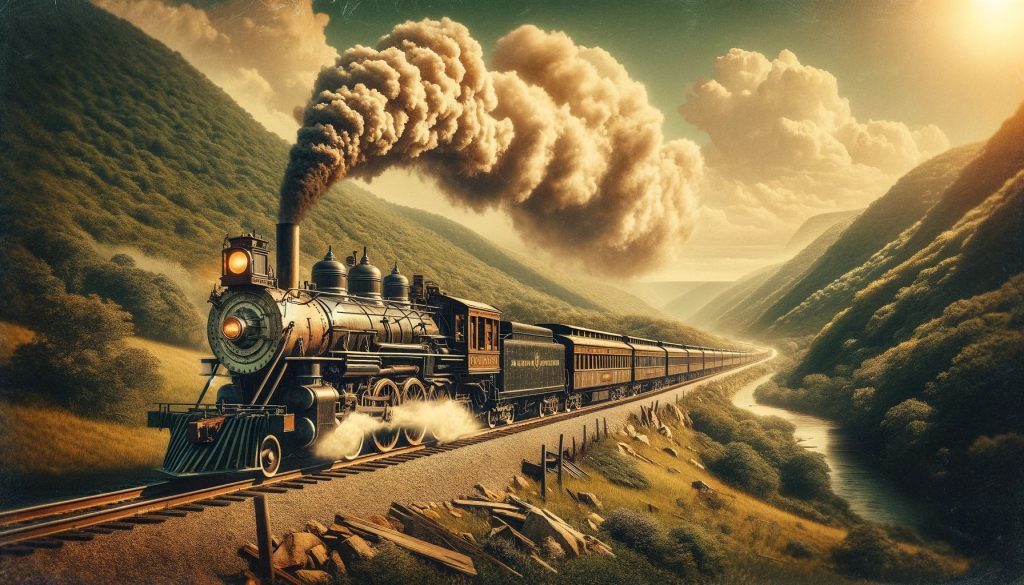
The rhythmic clack of iron wheels against steel rails, the billowing plumes of smoke, the whistle echoing through valleys – these are the evocative sounds of the Baltimore and Ohio Railroad (B&O), the first common carrier railroad in the United States. Born in 1830, the B&O’s story is one of innovation, transformation, and deep involvement in shaping the nation’s destiny. This article delves into the B&O’s history from 1830 to 1900, exploring its pioneering role in passenger service, technological advancements, and the evolution of its locomotive fleet.
Founding and Early Development (1827-1840)
The Baltimore and Ohio Railroad (B&O) stands as one of the most iconic and pioneering railroads in American history. Established in 1827, it became the first common carrier railroad and the oldest in the United States. Throughout its storied history, from 1830 to 1900, the B&O played a crucial role in shaping the nation’s transportation landscape, industrial growth, and economic development. This essay will explore the history of the Baltimore and Ohio Railroad during its formative years, highlighting its creation, expansion, technological innovations, challenges faced, and impact on American society.
The establishment of the Baltimore and Ohio Railroad was driven by a fierce economic rivalry between Baltimore and other burgeoning port cities like New York and Philadelphia. By the early 19th century, the state of New York had successfully opened the Erie Canal, creating a direct water route from New York City to the Great Lakes. This development threatened Baltimore’s status as a significant port city, prompting Baltimore businessmen to seek alternative means to connect their city with the American Midwest.
In 1827, Philip E. Thomas and George Brown, along with a group of prominent Baltimore merchants and bankers, founded the Baltimore and Ohio Railroad Company. The railroad’s primary goal was to provide an efficient means of transportation from the port of Baltimore to the Ohio River, thereby regaining the city’s competitive edge. On July 4, 1828, President John Quincy Adams laid the cornerstone of the B&O’s construction, marking the beginning of a new era in American transportation.
The first 13 miles of the B&O line, from Baltimore to Ellicott’s Mills (present-day Ellicott City, Maryland), were completed in 1830. This marked the first regularly scheduled passenger train service in the United States, a feat that drew national attention and established the B&O as a trailblazer in American railroad history.
The B&O’s initial construction utilized horse-drawn carriages on wooden rails, but this changed quickly. In 1830, the company introduced its first steam locomotive, the Tom Thumb, designed by Peter Cooper. Although the Tom Thumb famously lost a race to a horse-drawn cart due to a mechanical failure, the demonstration proved that steam power could rival traditional methods of transportation. The event marked the beginning of the steam era for the B&O and all future railroads in the country.
During the 1830s, the B&O continued expanding westward, reaching Harpers Ferry, Virginia (now West Virginia) by 1834. Harpers Ferry’s strategic location at the confluence of the Potomac and Shenandoah Rivers made it a critical junction for westward expansion, and the B&O’s arrival there underscored the company’s commitment to achieving its goal of reaching the Ohio River.
Expansion and Innovations (1840-1860)
By the 1840s, the B&O faced numerous challenges, including competition from other railroads and ongoing technical difficulties in crossing the Appalachian Mountains. Despite these challenges, the B&O pressed forward, continuously adopting new technologies and techniques to overcome the rugged terrain.
One of the most significant engineering achievements during this period was the completion of the Thomas Viaduct in 1835. Spanning the Patapsco River, the viaduct was the largest bridge of its kind at the time and remains a testament to the ingenuity of the B&O’s engineers. Its completion paved the way for further westward expansion and reinforced the company’s reputation as a leader in railroad construction.
The B&O’s most ambitious project during this era was the construction of the Kingwood Tunnel, which allowed the railroad to cross the Allegheny Mountains and reach Cumberland, Maryland, in 1842. By 1852, the company had extended its tracks to Wheeling, Virginia (now West Virginia), fulfilling its original goal of connecting Baltimore to the Ohio River. The successful completion of this route marked a turning point in the railroad’s history, solidifying its position as a vital link between the eastern seaboard and the American interior.
The 1850s also saw the introduction of new technologies and innovations in railroad travel, including the widespread adoption of the 4-4-0 “American Standard” locomotive. The B&O was one of the early adopters of this powerful and versatile design, which contributed to its ability to transport passengers and goods across increasingly long distances.
The Civil War and its Aftermath, Leading to an Era of Innovation and Expansion (1860-1890)
The outbreak of the Civil War in 1861 had a profound impact on the Baltimore and Ohio Railroad. Due to its strategic location, the B&O became a critical asset for the Union Army, serving as a major supply line connecting Washington, D.C., with the Midwest. Both Union and Confederate forces recognized the railroad’s importance, and as a result, the B&O faced constant threats, raids, and sabotage throughout the conflict.
One of the most notable events during the war was the Confederate raid led by General Stonewall Jackson in 1861. Jackson’s troops destroyed miles of track and infrastructure, significantly disrupting the railroad’s operations. Despite these challenges, the B&O’s leadership, under the direction of President John W. Garrett, demonstrated resilience and adaptability. The company rapidly repaired damaged tracks and bridges, ensuring the continuous movement of troops and supplies.
The end of the Civil War in 1865 marked the beginning of a new chapter for the B&O. With the nation’s attention shifting towards reconstruction and westward expansion, the railroad seized the opportunity to rebuild and modernize its infrastructure. The B&O played a pivotal role in facilitating the movement of goods and people to the newly opened territories in the Midwest, contributing to the country’s post-war economic recovery.
The period between 1870 and 1890 was characterized by rapid expansion and technological innovation for the Baltimore and Ohio Railroad. Under the leadership of John W. Garrett and later Charles F. Mayer, the company embarked on an ambitious campaign to expand its network and improve its services. The B&O extended its lines into the Midwest, reaching cities like Pittsburgh, Chicago, and St. Louis.
During this time, the B&O also introduced significant technological advancements, including the implementation of telegraph lines alongside its tracks. This innovation revolutionized communication and allowed for more efficient train scheduling and coordination. The B&O was also one of the first railroads to adopt air brakes and automatic couplers, which greatly improved the safety and reliability of its trains.
The railroad’s commitment to innovation was exemplified by the construction of the Sand Patch Grade, a challenging section of track in the Allegheny Mountains that required extensive tunneling and grading. Despite the technical difficulties, the completion of the Sand Patch Grade in 1874 opened up new opportunities for westward expansion and solidified the B&O’s position as a leading American railroad.
Economic Challenges and Reorganization (1890-1900)
The final decade of the 19th century was marked by economic challenges and organizational changes for the Baltimore and Ohio Railroad. The financial panic of 1893 had a devastating impact on the American railroad industry, and the B&O was no exception. The economic downturn resulted in a significant decline in passenger and freight traffic, forcing the company to cut costs and reorganize its operations.
During this period, the B&O faced increasing competition from other railroads, particularly the Pennsylvania Railroad, which had become a dominant force in the region. To remain competitive, the B&O embarked on a series of modernization efforts, including upgrading its locomotives and passenger cars and improving its track infrastructure.
Despite these efforts, the B&O struggled to regain its financial footing in the wake of the economic crisis. In 1896, the company underwent a major reorganization, which resulted in the appointment of new leadership and a renewed focus on efficiency and profitability. By the turn of the century, the B&O had stabilized its operations and was once again poised for growth in the rapidly evolving railroad industry.
Impact and Legacy
The Baltimore and Ohio Railroad’s history from 1830 to 1900 is a testament to the transformative power of rail transportation in the United States. The B&O not only pioneered the development of the American railroad industry but also played a critical role in shaping the nation’s economic, social, and technological landscape.
The railroad’s contributions to American society were manifold. It facilitated the movement of goods and people across vast distances, connecting cities and regions in ways that were previously unimaginable. The B&O’s expansion into the Midwest and its role in the nation’s westward expansion helped to fuel economic growth and urbanization, transforming the United States into a leading industrial power.
Technologically, the B&O was at the forefront of railroad innovation, introducing new designs, safety measures, and communication systems that would set the standard for the entire industry. The company’s commitment to continuous improvement and adaptation allowed it to overcome numerous challenges and remain a key player in the American railroad industry throughout the 19th century.
The B&O Lives On
Spoiler Alert: The Baltimore and Ohio Railroad ceased its independent operations in 1963 when the Chesapeake and Ohio Railway assumed financial control. Yet, the B&O endures in popular culture, immortalized as one of the iconic railroads in the classic Monopoly board game. This lasting presence is a testament to its historical significance and extensive geographic reach across the United States. Here’s a glimpse into how the B&O secured its place among the nation’s legendary railroads:
- Pioneering Spirit: The Baltimore & Ohio Railroads was America’s first common carrier railroad. Chartered in 1827, the B&O was the first U.S. railroad built for commercial transportation of both passengers and freight. This innovative approach set a precedent for the industry. The B&O was among the first railroads to adopt steam locomotives, significantly increasing transportation speed and efficiency.
- Engineering Marvels: The B&O faced numerous challenges during construction, including crossing the Allegheny Mountains. Its engineers devised creative solutions like the famous “Kingwood Grade” to overcome these obstacles, showcasing impressive engineering feats. The railroad pioneered many construction techniques that were later adopted by other railroads across the country.
- Strategic Importance: The B&O played a crucial role in connecting the East Coast with the growing Midwest, facilitating trade and westward expansion. During the Civil War, the B&O was a vital transportation lifeline for the Union, supplying troops and materials.
- 4. Cultural Impact: The B&O became a symbol of American progress and innovation, capturing the public imagination and inspiring countless stories and songs. The B&O’s rich history is celebrated today through museums, historical sites, and preserved locomotives, ensuring its legacy continues to inspire future generations.
Conclusion
The Baltimore and Ohio Railroad’s journey from 1830 to 1900 is a story of ambition, innovation, resilience, and transformation. From its humble beginnings as a solution to Baltimore’s economic rivalry with other port cities, the B&O grew into one of the most influential railroads in American history. Its pioneering spirit, technological advancements, and contributions to the nation’s growth and development have left an indelible mark on the history of transportation in the United States.
As we look back on the history of the B&O, it is clear that the railroad was more than just a means of transportation—it was a symbol of American progress, ingenuity, and determination. Its legacy endures, not only in the tracks and tunnels it built but also in the spirit of innovation and perseverance that continues to drive the American railroad industry to this day.