
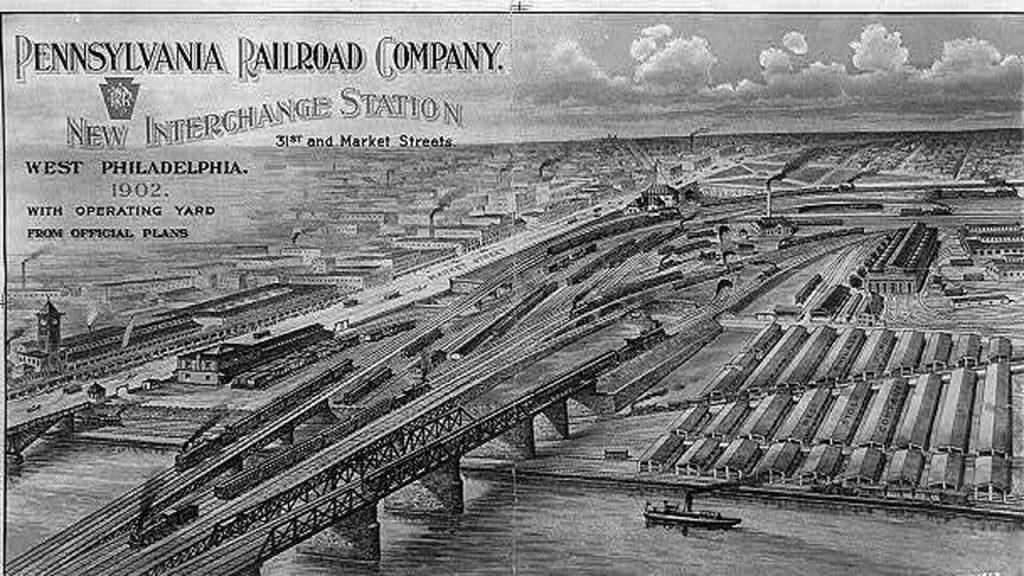
The Pennsylvania Railroad (PRR), founded in 1846, grew from a regional transportation venture into the largest corporation of its era, ultimately leading to its ill-fated merger with the New York Central Railroad in 1968. This comprehensive history explores its strategic rise, dominance, and eventual collapse into the Penn Central Transportation Company.
From Early Growth to a Golden Era
The Pennsylvania Railroad was incorporated on April 13, 1846, with the ambition of connecting Harrisburg to Pittsburgh and beyond. It quickly expanded by acquiring or merging with many smaller lines—over time consolidating more than 800 routes. By the late 1860s, the PRR had established itself as a primary transportation artery across Pennsylvania, linking Philadelphia, Pittsburgh, and Wilmington. Key to its early success was leadership under J. Edgar Thomson, who prioritized engineering excellence and timely expansion. Infrastructure investments—like the famous Horseshoe Curve, the Altoona Works, and electrification projects—positioned the PRR as a technical leader and a backbone of regional commerce.
By the turn of the century, PRR had earned its nickname as the “Standard Railroad of the World”, operating nearly 12,000 route miles by 1926 and handling traffic volumes far exceeding major peers like Union Pacific. Its network not only served freight and passenger markets but extended into Great Lakes maritime routes and the oil trade via its Empire Transportation Company.
In this era, the PRR introduced luxury passenger services such as the Broadway Limited, launched in 1912 to rival New York Central’s famed 20th Century Limited. With first-class dining, sleeping cars, and punctual schedules, PRR commanded high reputation among travelers.
Notable Achievements
Any story of the Pennsylvania Railroad’s is incomplete without discussing some of its remarkable engineering achievements. Two of those would be the Horseshoe Curve and the Hudson River tunnels leading to Penn Station. Today these construction achievements would be considered commonplace, but in the mid-nineteenth and early twentieth centuries, these were astonishing.
Horseshoe Curve: Conquering the Alleghenies
Completed in February 1854, the Horseshoe Curve was a breakthrough in allowing the PRR’s Main Line to cross the Allegheny Mountains without resorting to the inefficient Allegheny Portage Railroad’s chain-and-plane system. The curve stretches approximately 2,375 feet long and about 1,300 feet across, with a grade of 1.45%. Pittsburg bound trains climbed a maximum of 1.85% over long stretches. Its 220° bend enabled manageable elevation gain, eliminating steepness that would otherwise require frequent stops or helper locomotives. Prior to its construction, freight and passenger trains were slowed dramatically by the previous Portage Incline system.
Under Chief Engineer—and later PRR president—John Edgar Thomson, the curve embodied PRR’s engineering ethos: technical precision paired with operational necessity. Once open, it slashed travel times between Harrisburg and Pittsburgh to about 13 hours.
Beyond function, it became a public symbol. A visitor park was installed within the curve bowl by 1879; later improvements, including a general public observation road and locomotive memorial, cemented its tourist appeal. The curve gained recognition as a National Historic Landmark in 1966 and later as a National Historic Civil Engineering Landmark.
Today it remains in operation under Norfolk Southern—with thousands of freight and several Amtrak trains passing daily—and still draws rail enthusiasts to the Railroaders Memorial Museum and observation center.
Hudson River Tunnels & New York Penn Station
Until the early 1900s, Pennsy trains stopped in Jersey City. From there, passengers were ferried across the Hudson, limiting PRR’s competitive strength in New York City. This disadvantage against the railroad’s nemesis, The New York Central simply would not do. Determined to control direct access to Manhattan, PRR president Alexander Cassatt drew inspiration from Parisian electric railway tunnels. He initiated an ambitious plan: construct electrified tunnels beneath both the Hudson (then called the North River) and East Rivers and build a grand terminal in Midtown Manhattan.
Legislation, engineering innovation, and coordination with city officials were all critical. Despite opposition from local transit interests, the New York City Board of Aldermen approved the project in December 1902 by a narrow margin. Construction began in 1903**, with the first two North River Tunnels completed by October 9, 1906, and the four East River Tunnels by March 1908.
The tunnels measured about 18.5 to 19.5 feet in diameter, engineered to handle electric traction—essential since steam operation was forbidden inside Manhattan as of mid‑1908. The technological achievement included novel ventilation, waterproof linings, and pioneering use of electric locomotives developed expressly for this project. Pennsylvania Station opened fully on November 27, 1910, crowned by an 8‑acre complex with 21 tracks, 11 platforms, and a capacity to handle 144 trains per hour. Its design by McKim, Mead & White drew on classical Roman and Greek aesthetics—evoking the elegance of the Acropolis and Vatican colonnades.
The station immediately transformed commuter and intercity rail in the Northeast: within ten years, two‑thirds of daily riders were commuters, and PRR became the only railroad to enter NYC from the south. It connected routes from Chicago, St. Louis, and New England directly into Manhattan—opening vast new travel and transport possibilities.
Though tragically demolished in the early 1960s to make way for Madison Square Garden, Penn Station’s destruction sparked the modern landmark preservation movement in the U.S. Its departure helped secure protections for buildings like Grand Central Terminal, which PRR’s corporate successor sought to demolish in the late 1960s.
The tunnels themselves—crucial infrastructure on the Northeast Corridor—are still in use today under Amtrak and NJ Transit, carrying over 200,000 passengers daily and serving as a testament to PRR’s far-reaching engineering influence.
Together, these projects illustrate the Pennsylvania Railroad’s blend of technical mastery, infrastructure foresight, and corporate vision—setting benchmarks in civil engineering and urban mobility that resonated far beyond railroading. Let me know if you’d like to dive into electrification, station architecture, or PRR’s locomotive technology next.
Challenges and Mid-Century Transition (1930s–1950s)
Even as passenger demand peaked in the 1940s, revenues began a steady decline. In 1946, PRR reported its first-ever annual net loss. Factors included heavy regulation limiting rate flexibility, emerging competition from trucks and automobiles, and decline of industrial freight in the Rust Belt.
Steam locomotives were retired by 1957, and the same year saw informal merger talks commence with the New York Central. Meanwhile, the NYC was undergoing its own rejuvenation under Alfred Perlman, who modernized classification yards, dieselized operations, and introduced Flexi‑Van COFC (container on flat car) service.
The Long Road to Merger (1957–1967)
Initial merger discussions began in 1957 and faltered by early 1959. NYC pursued alternative partnerships with Chesapeake & Ohio and Baltimore & Ohio, but that effort also failed. By 1961, facing mounting industry pressure and regulatory challenges, NYC resumed talks with PRR. In April 1966, the Interstate Commerce Commission (ICC) approved the merger, which required Penn Central to also assume the struggling New York, New Haven & Hartford Railroad.
On February 1, 1968, the Pennsylvania Railroad legally absorbed the New York Central, adopting the name Pennsylvania New York Central Transportation Company. By May 8, 1968, the business began using the trade name “Penn Central”, later formalized as Penn Central Transportation Company. Penn Central controlled over 20,000 route miles, assets exceeding $5 billion, and employed more than 180,000 people—making it one of the largest corporations in the U.S. But the merger laid bare significant structural flaws from day one. Cultural clashes sapped morale: PRR’s traditionalist management and long-service workforce clashed with NYC’s younger, more innovative leadership. Meanwhile, duplication of parallel routes, terminals, and obsolete assets drove up costs. Chairman Stuart Saunders acquiesced to nearly all union demands—everyone from both companies was retained, separation payouts were generous, and many employees were rehired even without necessity, creating an inflated payroll with little efficiency gain. When the ICC mandated absorption of the money-losing New Haven Railroad at the end of 1968, Penn Central took on even greater financial burden. Mismanagement ensued: computerized systems failed to reconcile thousands of routing combinations, causing serious mismanagement of rail cars. One well‑publicized disruption saw cargo bound for Harrisburg misrouted to Pittsburgh simply due to unfamiliarity with the geography of the merged system.
Bankruptcy and Aftermath (1970–1976)
Financial hemorrhaging escalated rapidly, from a modest loss of $2.8 million to a staggering deficit in 1970 of nearly $326 million. Unfortunately, a last-minute $200 million federal bailout under the Defense Production Act was blocked by Congress, leaving Penn Central with no option but bankruptcy. On June 21, 1970, the company filed under Section 77, marking the largest corporate bankruptcy in U.S. history to that time.
In response to rising concern about passenger service disruption, the government established Amtrak on May 1, 1971, relieving Penn Central of its intercity passenger operations. By April 1, 1976, the federal government consolidated railroad assets—Penn Central and six other bankrupt northeastern railroads—into Conrail under the Regional Rail Reorganization Act of 1973.
Conrail eventually turned profitable, and in 1999 was split between Norfolk Southern and CSX Transportation, with NS inheriting most former PRR trackage. And with the recent news of the Norfolk Southern buyout and merger by Union Pacific, former Pennsy trackage will now be part of the first truly transcontinental railroad. The remnant Penn Central Corporation, no longer running trains, transformed into a financial and insurance entity, eventually rebranding as American Premier Underwriters in 1994.
Conclusion
From humble beginnings in 1846, the PRR grew into an industrial powerhouse, pioneering rail innovation and setting standards in freight and passenger service. Yet by mid‑20th century, systemic regulatory rigidity, declining traffic, and outdated infrastructure signaled impending crisis. The merger with New York Central, while intended to rescue and modernize, instead exposed structural faults: cultural clashes, duplicated assets, bloated labor costs, and poor integration. Penn Central’s collapse within two years of formation serves as a classic cautionary tale in corporate history—illustrating that mergers of scale do not guarantee synergy without thoughtful integration, aligned leadership, and a realistic operational strategy.
Today, remnants of the Pennsylvania Railroad’s legacy—iconic stations like New York-Penn Station, beloved passenger routes like the Broadway Limited (later run by Amtrak), and surviving trackage—remind us of a once-great network. But the lessons of its fall remain powerful: progress requires more than scale—it demands cohesion, adaptability, and prudent stewardship.