
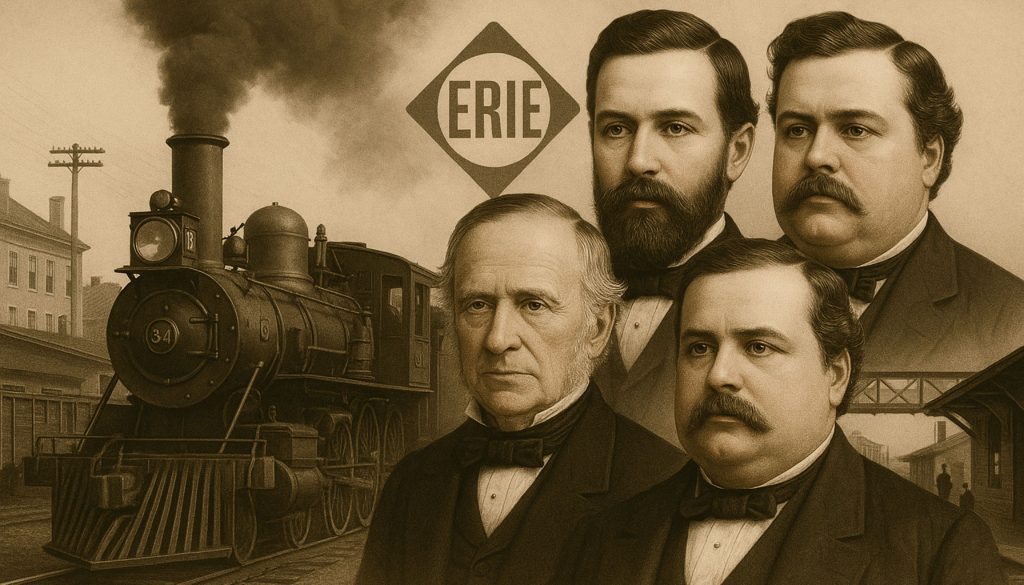
The late 19th century in America, often dubbed the Gilded Age, was a period of unprecedented industrial growth, technological innovation, and ruthless capitalist expansion. Amidst this rapid transformation, the railroad industry emerged as a powerful engine of economic development, connecting disparate regions and facilitating the movement of goods and people on an unimaginable scale. These iron arteries, crisscrossing the continent, were not merely transportation networks; they were the backbone of a burgeoning national economy, symbols of progress, and highly lucrative enterprises, making them prime targets for ambitious entrepreneurs and audacious speculators. However, this era of burgeoning enterprise was also characterized by fierce competition, speculative fervor, and a shocking degree of financial chicanery, often operating within a largely unregulated financial landscape. Among the most infamous episodes encapsulating these excesses was the “Erie War” of 1866-1868. This wasn’t a war fought with cannons and muskets on a battlefield, but a bitter, no-holds-barred financial battle for control of the strategically vital Erie Railway Company, involving some of the era’s most notorious titans of industry: Cornelius Vanderbilt, Daniel Drew, Jay Gould, and James Fisk.
The Erie War was far more than a mere corporate takeover bid; it was a dramatic collision of titans that vividly exposed the nascent, largely unregulated nature of American finance, the pervasive corruption deeply embedded within political systems, and the profound vulnerability of both legitimate businesses and the unsuspecting public to the avarice and manipulative machinations of powerful individuals. The conflict laid bare the destructive potential of financial manipulation, demonstrating in dramatic fashion how an insatiable pursuit of personal wealth and an unyielding desire for control could cripple vital public infrastructure, erode fundamental public trust in institutions, and send volatile shockwaves through the entire financial system. To fully comprehend the multifaceted significance of the Erie War, one must delve deeply into its complex origins, meticulously dissect the intricate web of financial deceit employed by its principal actors, and comprehensively analyze its far-reaching consequences on the actual operation of the railroad itself, as well as its broader, more systemic impact on society and the very foundations of American capitalism. It was a defining moment that revealed the urgent need for greater oversight in an era of rapidly expanding, yet unchecked, corporate power.
The Crucible of Conflict: Defining the Erie War
At its core, the Erie War was a brutal contest for ownership of the Erie Railway Company, a crucial transportation artery connecting the financial hub of New York City with the industrial and agricultural bounty of the Great Lakes region. The railroad, initially built with a mix of public subsidies and private investments, had a tumultuous history marked by chronic mismanagement, persistent financial indebtedness, and a fluctuating reputation, making it an attractive yet vulnerable target for exploitation by ambitious financiers. Into this volatile scene stepped Cornelius Vanderbilt, the formidable “Commodore,” a man who had already amassed an immense fortune in the cutthroat world of steamboats and was now relentlessly and aggressively consolidating his burgeoning empire in railroads. By the mid-1860s, Vanderbilt had successfully gained controlling interest of the New York Central Railroad, a rival and complementary line, and sought to integrate the Erie into his growing network, viewing it as a strategically imperative acquisition for extending his reach deeper into the resource-rich American West. His characteristic modus operandi was typically direct, unyielding, and financially aggressive: silently acquire enough stock on the open market to gain a definitive controlling interest, then swiftly assert his unchallengeable dominance over the company.
However, Vanderbilt’s characteristic ambition and straightforward strategy met its unexpected match in a formidable and audacious trio who came to be known collectively as the “Erie Ring”: Daniel Drew, Jay Gould, and James Fisk. Daniel Drew, an enigmatic and shrewd figure, had transitioned from a humble background as a cattle drover to become a highly successful, albeit ethically questionable, Wall Street financier. He possessed a long and intimate history with the Erie, having served on its board and shrewdly used his insider knowledge and manipulative prowess to profit immensely from its perpetually fluctuating stock prices. Drew was particularly notorious for his “bear” tactics, a strategy involving the borrowing of stock he did not yet own, subsequently spreading negative rumors or engineering events to drive down prices, buying back the shares at a significantly lower cost, and pocketing the substantial difference. When Vanderbilt initiated his silent, seemingly unstoppable acquisition of Erie stock, Drew, already firmly entrenched as a director and the powerful treasurer, quickly allied himself with two equally audacious and morally flexible figures: Jay Gould and James Fisk.
Jay Gould was a cunning and intellectually sharp financier, widely recognized for his relentless, almost pathological, pursuit of profit and his coldly strategic, often profoundly unethical, business acumen. He saw opportunities where others saw only chaos. James Fisk Jr., on the other hand, was a flamboyant and theatrical character, a former circus promoter whose audacious and flamboyant personality, replete with military uniforms and a penchant for public spectacle, masked an equally shrewd and utterly ruthless business mind. He was the public face of the Erie Ring, often acting as the enforcer and provocateur. Together, this unlikely triumvirate — the calculating and parsimonious Drew, the strategic and brilliant Gould, and the audacious and theatrical Fisk — formed a formidable and unpredictable opposition to Vanderbilt’s seemingly unstoppable takeover bid. Their collective motivation was not to improve the Erie Railroad’s dilapidated operations or its long-term viability, but rather to protect their existing entrenched interests, prevent Vanderbilt’s feared consolidation of power over the entire rail industry, and, most importantly, to profit immensely and immediately from the ensuing financial chaos they were prepared to engineer. The stage was thus set for a conflict that would not only redefine the boundaries of corporate warfare but also expose the glaring deficiencies in the regulatory and ethical frameworks of the burgeoning American financial markets.
The Art of Deception: Financial Manipulation and Its Operational Toll
The Erie War rapidly devolved into a dramatic and theatrical display of unparalleled financial chicanery, with the Erie Ring employing a series of audacious, often overtly illegal, tactics to thwart Vanderbilt’s advances. Their primary and most devastating weapon was “stock watering,” a term popularized, perhaps even invented, by Daniel Drew himself, who had adapted a deceptive practice from his earlier, less sophisticated cattle-driving days (where he would make cattle drink excessive amounts of water just before weighing them for sale to inflate their apparent mass). In the financial context, stock watering meant artificially inflating the stated value of a company’s assets or, more commonly during this era, issuing vast quantities of new shares without a corresponding increase in real capital, productive assets, or underlying economic value. It was, in essence, creating wealth out of thin air.
As Vanderbilt aggressively bought Erie stock on the open market, attempting to corner the existing supply and gain a definitive majority stake, the Erie Ring responded with an unprecedented countermeasure: they began to flood the market with newly printed, unbacked shares. In a move of incredible audacity and blatant disregard for corporate governance, the Erie board, acting entirely under the influence of Drew, Gould, and Fisk, authorized the issuance of an astonishing $10 million in new stock and convertible bonds. While this massive financial maneuver was ostensibly justified as necessary funds for vital railroad improvements (such as replacing worn-out iron rails with more durable steel rails or expanding lines), the true, cynical purpose was undeniably to dilute Vanderbilt’s existing holdings and to create an effectively endless supply of shares, thereby rendering it mathematically impossible for him to achieve the controlling interest he so desperately sought. Jim Fisk famously, and mockingly, boasted to reporters, “If this printing press don’t break down, I’ll be damned if I don’t give the old hog all he wants of Erie.” Vanderbilt, completely unaware of the clandestine, illegal printing operation and operating under the assumption of a finite stock supply, continued to buy relentlessly, pouring millions of his own hard-earned dollars directly into the Erie’s coffers, only to find his percentage of ownership continuously diluted with each new, fraudulent issuance. The Commodore eventually lost more than $7 million in this fruitless endeavor before realizing he was being systematically defrauded.
Beyond the infamous stock watering, the Erie Ring engaged in a litany of other manipulative tactics that directly undermined the railroad’s operational integrity and further destabilized its financial standing. They strategically spread false rumors through their network of contacts to destabilize stock prices, used their privileged insider knowledge of the railroad’s true (and often dire) financial state to profit from price fluctuations through rapid buying and selling, and, most notoriously, resorted to outright, systemic bribery of state legislators. When Vanderbilt, frustrated and enraged, finally obtained multiple court injunctions in New York to halt the fraudulent stock issuance and had warrants issued for the trio’s arrest, Drew, Gould, and Fisk famously fled across the Hudson River to Jersey City, New Jersey. From this seemingly safe haven, beyond the immediate reach of New York’s legal jurisdiction, they established a makeshift headquarters mockingly referred to as “Fort Taylor,” where they continued to direct their financial war against Vanderbilt with impunity. From this new base, they launched a counter-offensive, not only by drastically reducing Erie’s freight and passenger rates to undercut Vanderbilt’s competing lines (a move that, while harming Vanderbilt, further hemorrhaged the Erie’s legitimate, already meager, revenues) but also by engaging in a blatant and extensive campaign of political corruption. Jay Gould, demonstrating his unparalleled cynicism and ruthlessness, personally appeared in Albany, the state capital, with a satchel reportedly bulging with $500,000 in greenbacks, systematically distributing bribes to state senators and assemblymen to secure the passage of a bill that would retroactively legalize their fraudulent stock issues. This naked and public display of legislative capture highlighted in shocking detail how private financial battles could completely hijack the political process, transforming public policy and the very rule of law into a mere tool for private gain, further eroding public trust.
The direct impact of these machinations on the Erie Railroad’s actual operations was nothing short of devastating. The company, a vital piece of national infrastructure, became a mere pawn in a high-stakes game of financial chess, its valuable assets, its operational efficiency, and its very future being systematically mortgaged and depleted for the personal enrichment and power struggles of its opportunistic controllers. Funds that should have been prudently invested in improving the railway’s aging infrastructure, enhancing its safety protocols, and upgrading its operational efficiency were instead wantonly diverted into endless legal battles, corrupt political bribes, and the rapidly swelling personal fortunes of Drew, Gould, and Fisk. The constant financial instability, the perpetual threat of insolvency, and the widespread perception of fraud made it incredibly difficult, if not impossible, for the Erie to attract legitimate, long-term investment or to operate effectively as a stable, reliable transportation enterprise. Its once-respectable reputation plummeted to an all-time low, earning it the infamous moniker “the scarlet woman of Wall Street,” a name that became synonymous with bankruptcy, relentless litigation, and utter corporate failure. The entire operational focus of the railroad shifted entirely from providing dependable and efficient service to manipulating stock prices and enriching its controllers, leading to chronic mismanagement, deferred maintenance, dilapidated equipment, and a perpetual state of financial distress. Ultimately, this rapacious exploitation, driven by unbridled avarice and a complete disregard for the public good, directly led to the Erie Railway Company officially declaring bankruptcy in 1878, a stark and undeniable testament to how financial manipulation, when unchecked by ethical considerations or robust regulatory oversight, could utterly destroy a vital public utility and undermine the very foundation of its existence.
The Rippling Effects: Impact on the Public and Financial System
The Erie War’s profound repercussions extended far beyond the exclusive boardrooms and bustling stock exchanges, casting a long and dark shadow over the American public and its nascent, largely unsophisticated financial system. The most immediate and widely visible impact on the public was the profound and deeply unsettling erosion of trust in both financial institutions and the integrity of their government. The blatant and widely publicized bribery of elected officials, openly discussed and meticulously investigated by public committees, demonstrated a shocking level of corruption that, even in the cynical atmosphere of the Gilded Age, deeply shocked and angered the populace. The American public witnessed firsthand how powerful capitalists, driven by insatiable greed, could brazenly manipulate the law and buy political influence, leading to widespread disillusionment with the integrity and fairness of the entire system. Citizens began to question the very foundations of democracy when legislative decisions appeared to be for sale to the highest bidder.
Furthermore, the rampant speculative frenzy and the insidious issuance of watered stock directly and severely harmed countless unsuspecting investors, from wealthy individuals to those of more modest means. Many ordinary individuals, drawn by the allure of quick profits in the booming railroad sector, invested their hard-earned savings in Erie shares, only to see their investments catastrophically diluted and their fortunes vanish into thin air as the true, inflated, and fraudulent nature of the stock became horrifyingly apparent. This blatant exploitation of ordinary citizens by powerful, unprincipled financiers became a powerful rallying cry for public outrage and fueled increasingly vocal demands for greater corporate accountability and governmental oversight. The stories of ruined families and lost life savings created a deep-seated public resentment against the “robber barons.”
Perhaps the most dramatic and ultimately far-reaching consequence on the American public, stemming directly from the financial methods perfected and unleashed during the Erie War, was the infamous “Black Friday” gold panic of 1869. Just a year after the Erie War’s climax, Jay Gould and James Fisk, having refined their manipulative tactics, boldly attempted to corner the entire nation’s gold market. Utilizing a complex and deeply deceptive scheme involving highly placed political connections (including a particularly egregious and deceptive relationship with President Ulysses S. Grant’s unsuspecting brother-in-law), coupled with massive, speculative purchases of gold, they aimed to artificially drive up the price for immense personal profit, irrespective of the economic damage inflicted upon others. When the federal government, finally recognizing the impending crisis, belatedly intervened by selling its own gold reserves to break the corner, the market crashed with terrifying speed, leading to widespread bankruptcies, profound economic turmoil, and devastating financial losses for countless legitimate businesses and individuals across the entire country. Black Friday served as a stark, painful, and widely publicized national lesson in the systemic dangers of unchecked financial speculation and rampant manipulation, directly illustrating the broader societal harm that such morally bankrupt schemes could inflict on the economy and the lives of ordinary Americans.
On the financial system itself, the Erie War was a pivotal, albeit incredibly painful, learning experience. It unsparingly exposed gaping holes in existing corporate law and revealed the almost complete absence of effective regulatory oversight. Prior to the war, practices like stock watering were either not strictly defined as illegal or were exceedingly difficult to prosecute under the vague and insufficient existing statutes. The public outcry and the sheer scale of the financial conflict spurred a critical and much-needed examination of how corporations issued stock and managed their capital. Investigations, most notably the Hepburn Committee report in 1879, thoroughly confirmed the alarming prevalence of stock watering throughout the entire rail industry, particularly noting the existence of “fictitious capital” and the rampant issuance of stock purely for speculative purposes rather than genuine investment. This widespread abuse eventually led to significant and necessary reforms in corporate law, including the crucial move towards issuing shares with low or even “no par value.” This reform was a direct and deliberate response to the significant problem of investor liability for watered stock, aiming to legally protect unsuspecting shareholders from being held personally responsible for the difference between the inflated stated par value and the actual, much lower, capital genuinely contributed to the company.
Moreover, the Erie War vividly highlighted the rudimentary and often chaotic nature of financial markets at the time, underscoring the urgent need for more robust and enforceable regulatory mechanisms. The shocking spectacle of legal injunctions being issued and then brazenly ignored, and of powerful financiers fleeing across state lines to evade arrest, underscored the fragmented, inconsistent, and often utterly ineffective legal framework governing interstate commerce and corporate behavior. While immediate, comprehensive federal regulation of financial markets was still decades away from realization, the Erie War undeniably contributed significantly to a growing awareness among influential policymakers, legal scholars, and the general public that the theoretical “invisible hand” of the market needed some visible, tangible guidance and effective governmental oversight to prevent such catastrophic abuses and safeguard the public interest. It thus laid some of the crucial groundwork for future financial regulations, including the eventual establishment of institutions designed to bring greater transparency, accountability, and stability to the burgeoning corporate world. The era of the “Robber Baron,” so vividly epitomized by figures like Gould and Fisk and their actions during the Erie War, became firmly solidified in the public consciousness, shaping a lasting, critical narrative about the profound ethical compromises inherent in unbridled capitalism and fueling powerful populist movements that would demand increasingly greater government intervention in the economy and a more equitable distribution of wealth.
Conclusion: A Legacy of Reckoning
The Erie War stands as a powerful and enduring cautionary tale in the annals of American financial history. It was a vicious and unprincipled struggle for corporate control, executed with a shocking degree of audacity, pervasive deceit, and systemic political corruption. The conflict profoundly impacted the Erie Railroad itself, transforming a vital transportation asset into a battleground for speculative gain, leading inevitably to its chronic mismanagement, deep financial distress, and eventual ignominious bankruptcy. The railroad, originally established to serve the public good by facilitating commerce and travel, became a mere casualty of the very forces supposedly meant to develop and nurture it.
Beyond the unfortunate fate of a single railway, the Erie War had far-reaching and transformative consequences for the American public and its nascent financial system. It fundamentally shattered public trust in the integrity of both the business world and the government, demonstrating with alarming clarity how easily legislative bodies could be swayed and compromised by the lure of vast sums of money. The subsequent Black Friday gold panic, a direct spiritual successor and chilling demonstration of the same manipulative tactics refined during the Erie conflict, served as a traumatic national lesson in the devastating systemic dangers of rampant financial manipulation when left unchecked. Most significantly, the war exposed the glaring deficiencies in corporate law and financial regulation, critically laying the groundwork for crucial future reforms explicitly aimed at curbing speculative excesses, providing essential protection for unsuspecting investors, and fostering greater accountability and transparency in the rapidly expanding and increasingly complex world of big business.
While the Gilded Age was widely characterized by an almost unshakeable belief in the virtues of laissez-faire capitalism and minimal government intervention, the Erie War provided undeniable and painful proof that unchecked ambition, coupled with sophisticated financial manipulation, could lead directly to widespread economic instability and profound public suffering. It became a powerful and enduring symbol of the “robber baron” era, forcing a national reckoning with the complex ethical dimensions of wealth accumulation, the exercise of corporate power, and the responsibility of those who wield it. The bitter lessons learned from the Erie War, though painful and costly, undeniably contributed to a gradual, yet incremental, shift towards greater governmental oversight and regulation, fundamentally shaping the trajectory of American financial markets and the principles of corporate governance for decades to come. Its legacy endures as a stark and potent reminder of the delicate yet crucial balance required between fostering economic dynamism and upholding the imperative for integrity, transparency, and social responsibility in the relentless pursuit of wealth and power.